How much does a screed cost per m² in Belgium? Price ranges by type, six factors that influence the quote, frequently overlooked items, and how to compare two quotes on an equal footing.
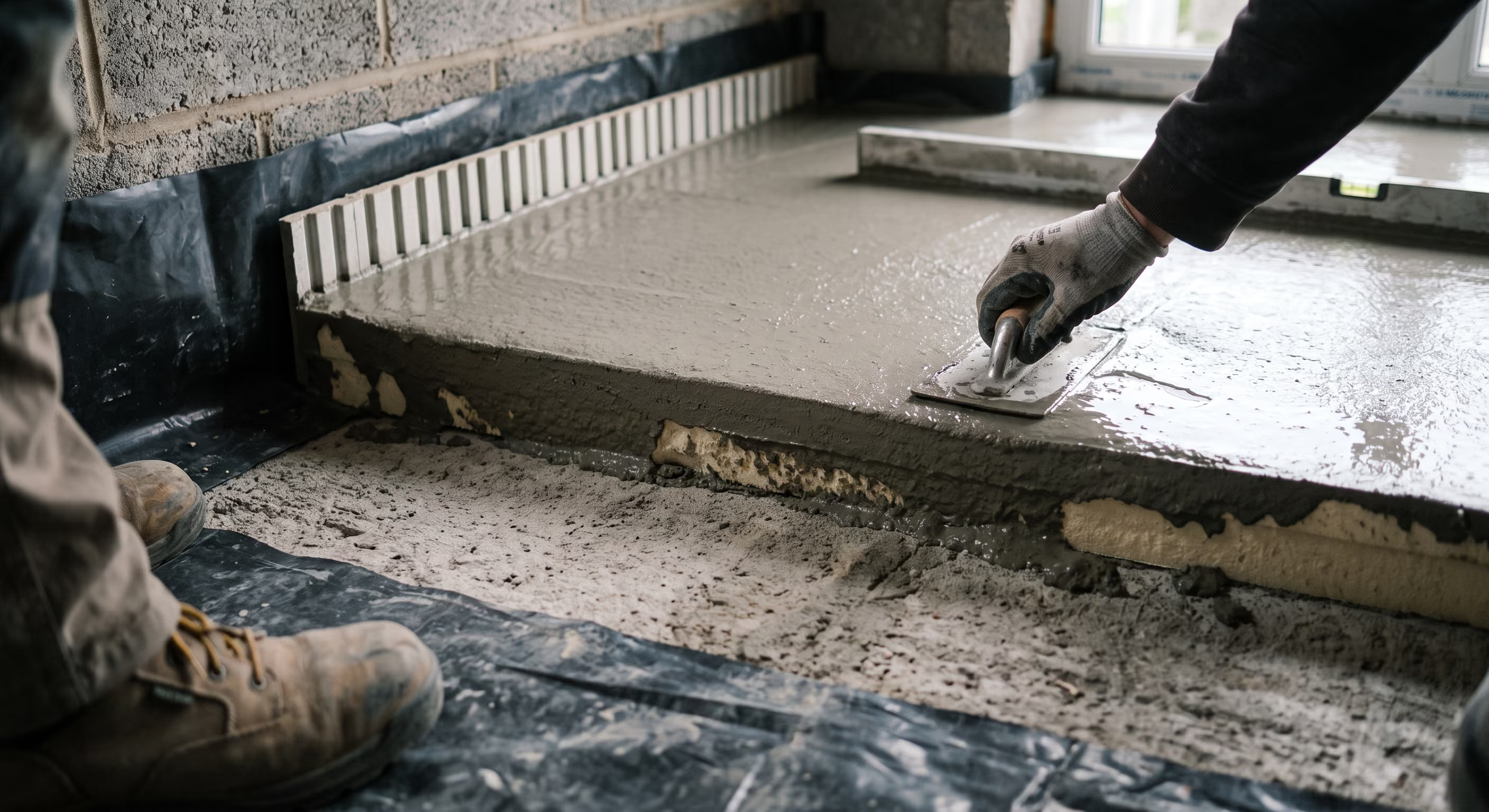
In Belgium, the price of a screed generally ranges between €20 and €55/m², installation included. This is a wide range because it covers very different situations: the type of screed, the surface area, site access, and thickness can cause the quote to double for the same property.
The essentials in three points
Last updated: August 2026
If you have checked three websites, you have likely found three incompatible price ranges. Vloerman places traditional screed between €35 and €55/m² in Belgium. Trustup lists €20 to €30/m² for a liquid screed. Other comparison sites go much higher.
These discrepancies are not due to market inaccuracy. They stem from four differences in scope that are rarely explained.
In other words, a price per square meter taken out of context doesn't mean much. It is useful for setting a budget, not for comparing two companies.
These ranges reflect what is observed on the Belgian market in 2026, including installation. They do not replace a quote provided after an on-site visit.
This is the most underestimated factor. Travel, pump setup, equipment cleaning, and installation time barely vary between a small and a large project. These fixed costs are spread across the total area.
A direct consequence: below 100 m², the price per square meter rises significantly. The Prix Travaux au m² website notes that a 150 m² project can be around €20 to €25/m², while a 50 to 70 m² project reaches €30/m² for identical work.
The thicker the screed, the more material is required. The effect is real but moderate, because the thickness varies within a narrow range, generally between 4 and 8 cm.
However, thickness has a significant indirect effect on the schedule: it extends the drying time, which delays the installation of the flooring and everything that follows.
Liquid screed is pumped from a truck. If the truck can park in front of the house and run a hose to the room, the application is quick.
A third-floor apartment with no direct access, a narrow street, a long pumping distance, or a site where everything must be carried up stairs changes the equation. This is often the factor, invisible in price comparison tools, that explains the difference between two quotes for an apparently similar project.
A clean, level subfloor requires no preparation. A dusty, greasy, damaged, or uneven surface requires prior treatment: stripping, primer application, or sometimes partial demolition.
These tasks are not included in a standard price per square meter. They appear after the site visit, which is standard practice.
A screed over underfloor heating requires sufficient thickness above the pipes, a liquid screed in most cases, and a documented heating start-up protocol. The cost is higher than for a standard screed, and the wait time before installing the flooring is longer.
If the project includes thermal or acoustic insulation under the screed, it is a separate line item. However, it may qualify for regional grants, which changes the final calculation.
A quote showing a flat rate per square meter doesn't necessarily include everything the project requires. The following items are often handled separately or overlooked.
The absence of these items doesn't mean the company is dishonest. It means the quote cannot be compared to another that includes them.
Three checks are enough to make two quotes comparable.
The applicable VAT rate. For a property over 10 years old, the VAT on work is 6%. For properties under 10 years old, it is 21%. On a €5,000 invoice, the difference is approximately €750. A quote excluding VAT cannot be compared line-by-line with a quote including VAT.
The type of screed and its thickness. A 5 cm cement screed and an anhydrite screed of 7 cm over insulation are not the same type of work. The quote must specify both.
What is included underneath and around it. Insulation, film, perimeter strips, joints: these items change the total by several euros per square meter.
A quote that details these elements is often higher than one that omits them. The former generally reflects the actual cost of the project.
There are a few ways to do this, but they are not all equal.
Grouping areas together is the most effective. Pouring the entire ground floor in a single visit is significantly cheaper than three separate visits spread out over time.
Preparing access before the team arrives: clear the room, provide a parking space, and ensure access to water and electricity.
Plan ahead rather than paying for a fast-drying screed. These products are more expensive and are only justified when the schedule demands it, not when ordering earlier would have sufficed.
However, skimping on thickness or replacing a screed with a self-leveling compound when the situation requires a structural layer is a false economy. You will pay for it in cracks, and repairs will cost more than the original screed.
A price per square meter is useful for setting a budget. It does not replace a quote, because no estimate can account for the condition of your subfloor, the height available, or how close the truck can get.
Davide Chape provides quotes after assessing the subfloor, detailing every aspect: screed type, thickness, insulation, perimeter strips, joints, and moisture testing. You know exactly what you are comparing. Request a free quote, or browse our screed solutions.

Do not hesitate to contact us directly: our team is always available to assist you and provide a 100% free quote.


Your expert in screeds, thermal insulation, and acoustic floor insulation.