Cold floor? Seven possible causes: no insulation, cellar, thermal bridge, damp, tiles, draughts or underfloor heating. Spot the signs, pick the right fix.

A cold floor almost always has one of seven causes: an uninsulated floor on the ground, an unheated cellar or crawl space underneath, a thermal bridge along the walls, damp, a floor finish that draws heat from your feet, draughts under the skirting boards, or badly set underfloor heating. Each one shows clear signs. Identifying them first stops you paying for work that will not solve anything.
The essentials in three points
An infrared thermometer is enough for a first diagnosis. Measure the floor temperature in the middle of the room, then 20 cm from an outside wall and in front of the front door or cellar door. Note the air temperature at the same time.
Three readings come out of this. If the floor is between 19 and 29 °C everywhere, the comfort range set by EN ISO 7730, the floor is not cold: the floor finish creates the feeling. If it is clearly colder everywhere, heat is escaping downwards. If it is cold only along the walls or at the thresholds, the problem is at the edges.
Also note when the cold appears. Cold that gets worse on windy days points to draughts. Dark patches at the foot of the walls point to damp. These observations lead you to one of the seven causes below.
A floor laid directly on the ground, with no insulating layer, loses heat to the soil all the time. This is the case in most older houses: in Flanders, more than half of homes have no floor insulation (VEA, 2019).
How to recognise it. The floor is cold across the whole room, with a marked gap between air and floor temperature in the heating season. There is no cellar or crawl space under the room. A thick rug improves the feeling but does not change the measured temperature.
A screed alone changes nothing: it levels the floor and carries the finish, but it does not insulate. The difference between a screed on insulation and a screed poured straight onto the slab is explained in our article screed with or without thermal insulation.
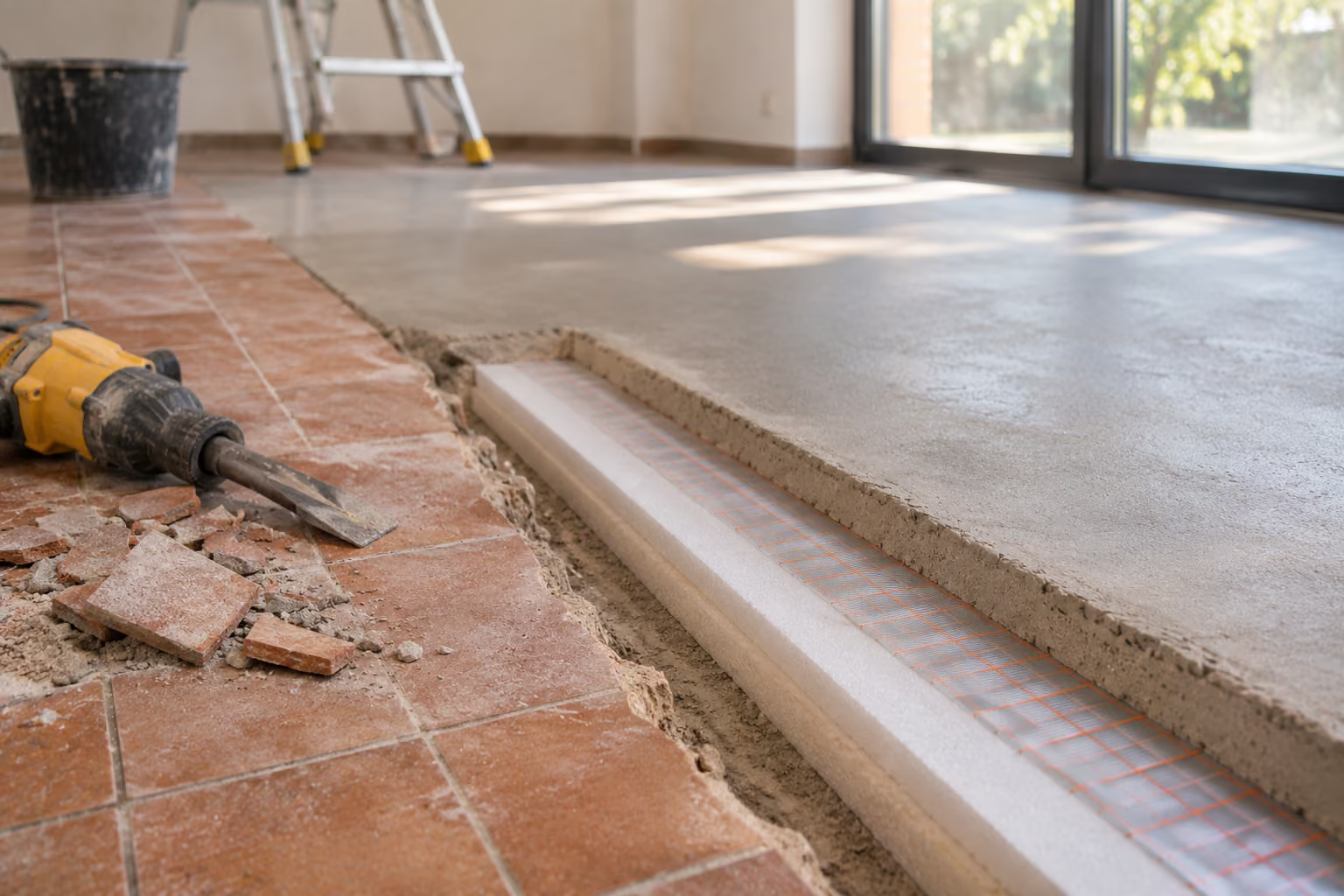
The fix. On the ground, you can only insulate from above. There are two routes: strip the floor back to the slab and rebuild it with insulation and a new screed, or insulate on top of the existing floor and accept a higher floor level. How to choose is covered in our article insulating an existing floor: break it out or keep it. The material is then a choice between sprayed PUR and EPS mortar.
Scale of the work: heavy. The room is out of use during the works and while the new screed dries.
A floor above a cellar or crawl space sits over a cold space. That floor is part of the building envelope, just like an outside wall.
How to recognise it. The room is above a cellar or crawl space. The cold is often strongest near the cellar door or the cellar stairs. On the cellar ceiling, you can see the bare slab, brick vaults or joists, with no insulation.
The fix. When the space is accessible, the insulation goes underneath, on the ceiling of the cellar or crawl space, without touching the ground floor. Sheet 6 of the Walloon guide "Rénover pour consommer moins d'énergie" (SPW Énergie) describes this as the simplest and cheapest solution. Homegrade, the Brussels renovation advice centre, points out in its brochure on cellar ceilings (2024) that the cellar stairwell should also be better closed off and the cellar door insulated, so the insulation stays continuous.
A crawl space must remain ventilated after insulation: ventilation is what keeps it dry. Its role and constraints are explained in our crawl space glossary entry. The techniques suited to each base, slab, vaults or timber floor, are set out in our guide floor insulation by substrate.
Scale of the work: medium. The work is done from below, and the living areas remain usable.
A thermal bridge is a spot where the insulation is interrupted. On a floor, it is usually found at the junction between the slab and the outside walls, and under door thresholds.
How to recognise it. The middle of the room is at a good temperature, but a strip along the outside walls is clearly colder on the infrared thermometer. Condensation or mould appears in the corners, at the foot of the walls. The front door threshold is icy.
The fix. A thermal bridge is treated by making the floor insulation meet the wall insulation. This is a key point in any floor insulation job: the insulation must run up to the walls and under the thresholds, without a break. A seamless sprayed layer such as PUR limits gaps around pipes and uneven areas. The typical thermal bridges of a floor are described in our thermal bridge glossary entry.
Scale of the work: medium to heavy. It is rarely treated on its own, but as part of insulating the floor or the walls.
A damp floor feels colder than a dry one. Water conducts heat better than the air held in building materials, and evaporation cools the surface.
How to recognise it. Dark tide marks appear at the foot of the walls, sometimes with white salt deposits. According to sheet FARCC 03.06 from the Walloon Heritage Agency, based on Buildwise technical note NIT 252 (2014), rising damp climbs on average 50 to 150 cm into masonry and leaves darker waves. Tile joints darken, skirting boards come loose, and a cellar smell lingers.
A simple test confirms it: a square of plastic sheet taped to the floor for 24 to 48 hours. The full method is in our wiki entry pouring a screed on a damp base.
The fix. Treat the cause before any insulation: drainage, an injected damp-proof barrier or a leak repair, depending on the source. Pouring a screed or laying insulation on a damp floor only traps the problem. The floor finish ends up coming loose.
Scale of the work: variable. The diagnosis is a job for a damp specialist, and the treatment always comes before insulation.
At the same temperature, tiles feel colder than wood. This is not an illusion: tiles absorb heat from the skin much faster. Physicists call this property thermal effusivity.
Your bare foot therefore loses heat much faster on tiles, and your brain reads that loss as cold. The Belgian non-profit ecoconso sums it up: at the same air temperature, you are more comfortable with your feet on a rug than on tiles.
How to recognise it. The thermometer shows a floor within the comfort range, yet it feels cold barefoot. The cold disappears in slippers or on a rug. Rooms with wooden floors in the same house feel warmer.
The fix. Rugs and slippers remove the feeling. A less effusive finish, such as wood, cork or vinyl, reduces it for good. Underfloor heating makes tiles pleasant, because it warms the surface itself. Note that changing the floor finish does not reduce heat loss if the floor is not insulated.
Scale of the work: light for a rug, medium for a new floor finish.
Cold air gets in through gaps between the floor and the walls, between the boards of an old timber floor or around the cellar door. The cold feeling then comes from the air, not the floor.
How to recognise it. You feel the cold at your ankles more than under your feet. It gets clearly worse on windy days. The floor is an old timber floor above a cellar or crawl space. Running the back of a wet hand along the skirting boards, you feel a stream of air.
The fix. Seal the gaps: a flexible sealant under the skirting boards, filling the gaps between floorboards, a draught strip on the cellar door. Homegrade advises checking that ground-floor boards fit tightly and that their gaps are sealed before insulating the cellar ceiling below. Never block the home's ventilation grilles or the air vents of a crawl space.
Scale of the work: light. A few hours of work, often without a contractor.
Underfloor heating is not meant to give a hot floor, but a lukewarm one. The European standard NBN EN 1264 limits the surface temperature to 29 °C in occupied areas. Underfloor heating that only feels lukewarm to the touch can therefore be working perfectly.
How to recognise it. The floor stays cold while the heating is running, or some areas stay cold. The room takes a very long time to warm up after the thermostat has been turned down. The loops on the same manifold are not at the same temperature.
The fix. In most cases it is a matter of settings: a heating curve set too low, too deep a night setback for a slow system, air in the pipes, or poorly balanced loops. A heating engineer can check these points in a few hours. If the cold comes from missing insulation under the pipes, the heat disappears into the slab: only rebuilding the floor fixes that. The role of insulation and screed in underfloor heating is explained in our article screed for underfloor heating.
Scale of the work: light for adjusting settings, heavy if insulation is missing under the pipes.
This table sums up the seven causes. Several can combine: an old floor above a cellar is often both uninsulated and draughty.
| Symptom | Likely cause | Fix | Scale of work |
|---|---|---|---|
| Whole room cold, below 19 °C, no cellar underneath | Uninsulated floor on the ground | Insulate from above: strip back to the slab or insulate on top of the existing floor | Heavy: floor rebuilt, new screed |
| Cold floor above a cellar or crawl space, bare cellar ceiling | Unheated space under the floor | Insulate from below, on the cellar or crawl space ceiling; close off the cellar stairwell | Medium: living areas untouched |
| Cold strip along outside walls, mould in the corners | Thermal bridge at the edges | Make floor and wall insulation meet, including under thresholds | Medium to heavy: with floor or wall insulation |
| Dark tide marks at the foot of walls, salts, darkening joints | Damp, rising damp | Treat the cause (drainage, injection, leak) before any insulation | Variable: diagnosis by a specialist |
| Floor between 19 and 29 °C but cold barefoot, especially on tiles | High-effusivity floor finish | Rugs, slippers, wood, cork or vinyl, or underfloor heating | Light to medium |
| Cold ankles, worse on windy days, old timber floor | Draughts under skirting boards and between boards | Flexible sealant under skirting, gaps filled, draught strip on the cellar door | Light: a few hours |
| Underfloor heating on but floor or areas stay cold | Settings, air, balancing, or no insulation under the pipes | Have heating curve, bleeding and balancing checked; rebuild if insulation is missing | Light (settings) to heavy (insulation) |
The order of the work matters as much as the choice of work. Starting with the cheapest is not enough: start with what determines the rest.
Floor insulation also affects your energy bill. According to ecoconso, lowering the thermostat by a single degree saves around 7%. A floor that is no longer cold often makes that possible without losing comfort.
Davide Chape insulates floors with sprayed PUR and EPS mortar, on slabs as well as in cellars and crawl spaces, and lays the screed on top, throughout Belgium. Every quote is preceded by an on-site assessment: base, available height, damp and access from below.
See our thermal floor insulation solutions or request an assessment of your cold floor.
Last updated: November 2026. Sources: VEA, Verhogen van de renovatiegraad van bestaande woningen, Renovatiepact 2.0 working paper (September 2019), cited by West-Vlaanderen Werkt (2020); EN ISO 7730, ergonomics of the thermal environment; NBN EN 1264, underfloor heating systems; SPW Énergie, guide "Rénover pour consommer moins d'énergie", sheet 6; Homegrade, brochure "Isoler le plafond des caves" (2024); Walloon Heritage Agency, sheet FARCC 03.06, and Buildwise, NIT 252 (2014); ecoconso, "Le confort thermique" advice sheet (accessed November 2026).

Do not hesitate to contact us directly: our team is always available to assist you and provide a 100% free quote.


Your expert in screeds, thermal insulation, and acoustic floor insulation.