Screed quote: area, NBN EN 13813 class, thickness, membrane, edge strips, insulation, drying, ten-year insurance and VAT. A line-by-line checklist.

A good screed quote describes the work before it prices it. It states the area and how it was measured, the screed type and its class under NBN EN 13813, the thickness, the separating membrane, the edge strips, any insulation with its R-value, the base preparation, drying, insurance, VAT and payment terms. Every missing line is a question to ask before you sign.
The essentials in three points
A screed quote commits both parties to a specific piece of work. If a line stays vague, the contractor's reading of it applies on the day, not yours.
The total tells you nothing about what is actually planned. Two quotes for "screed, 80 m²" can mean a 6 cm floating screed on insulation or a 4 cm bonded screed with no membrane and no edge strips. That is not the same work, the same comfort or the same lifespan.
This article is not about prices. Belgian market rates and the method for putting two quotes on the same price basis are in our article on the price of a screed per m² in Belgium. Here, we check that the quote describes the right work.
The table below lists the lines a complete screed quote should contain. Read it with your quote next to it, line by line.
| Quote line | What it must state | Warning sign |
|---|---|---|
| Area | m² per room, measured on site or from a plan, thresholds and excluded zones | A rounded total with no detail, estimated without a visit |
| Screed type | Traditional, cement flowing screed, anhydrite, fast-drying, insulating | Just « screed » |
| Mortar class | NBN EN 13813 class (e.g. CT-C20-F4) or composition, data sheet available | No class or composition, data sheet refused |
| Thickness | Thickness in cm, minimum or average, cover above pipes with underfloor heating | No figure, or « depending on base » |
| Membrane and decoupling | Membrane on insulation, vapour barrier if the base is exposed to damp | Floating screed with no membrane listed |
| Edge strips | Along walls, columns and door frames | Missing from the quote |
| Mesh, fibres and joints | Reinforcement or not, type, control joints | Large area or underfloor heating with no joints planned |
| Insulation | Technique, thickness, product or λ, R-value achieved | Thickness with no R-value, or just « insulation » |
| Base and preparation | Cleaning, primer, repairs, breaking out: included or left to you | Nothing on the base, extras « to be assessed » |
| Access, travel, pump | How the mortar arrives, pumping distance, floor level | Access not described for an upper floor or narrow street |
| Protection and drying | Who protects the screed, estimated time, moisture test planned and by whom | Short drying time guaranteed with no test or suitable product |
| Insurance | Ten-year insurance if an architect is required, certificate, professional liability | No insurer or policy number |
| VAT | Rate applied (6% or 21%) and why | 6% on a new build, or no rate |
| Payment and validity | Deposit, instalments, balance tied to the end of the job, validity period | Balance demanded before the work is finished |
A missing line does not prove a contractor is unreliable. It only means the point has not been settled. Ask the question in writing and request a revised quote: that document is what counts, not what was said on site.
The area is the basis of the whole quote, and it can be calculated in several ways. The quote should say whether it was measured on site or taken from a plan, and whether it is given room by room or as one total.
Three details change the figure:
An area measured during a site visit is more reliable than one estimated remotely. Davide Chape, for example, draws up its quotes after a visit and measurements on site.
The screed type is the most important line. "Screed" alone is not enough: the quote should say whether it is a traditional sand and cement screed, a cement-based flowing screed, an anhydrite screed, a fast-drying screed or an insulating screed. The differences and the right choice for each project are in our guide to choosing a screed.
The European standard EN 13813, published in Belgium as NBN EN 13813, classifies screed materials with a string of letters and numbers. On a technical data sheet you will read, for example, CT-C20-F4:
This class appears on the data sheet of ready-mixed mortars. A screed mixed on site from sand and cement does not always have a declared class, so the quote should then state its composition. Either way, ask for the product data sheet. The Belgian rules of workmanship are those of Buildwise technical notes NIT 189 and 193.
The thickness should be given in centimetres, and you need to know what it refers to. A "minimum" and an "average" thickness do not mean the same thing on an uneven base. With underfloor heating, what matters is the cover above the pipes, not the total thickness.
Minimum thicknesses by screed type and base (bonded, floating, heated) are in our article on screed thickness by type and base. Compare the thickness on the quote with these benchmarks: a floating screed that is too thin will crack.
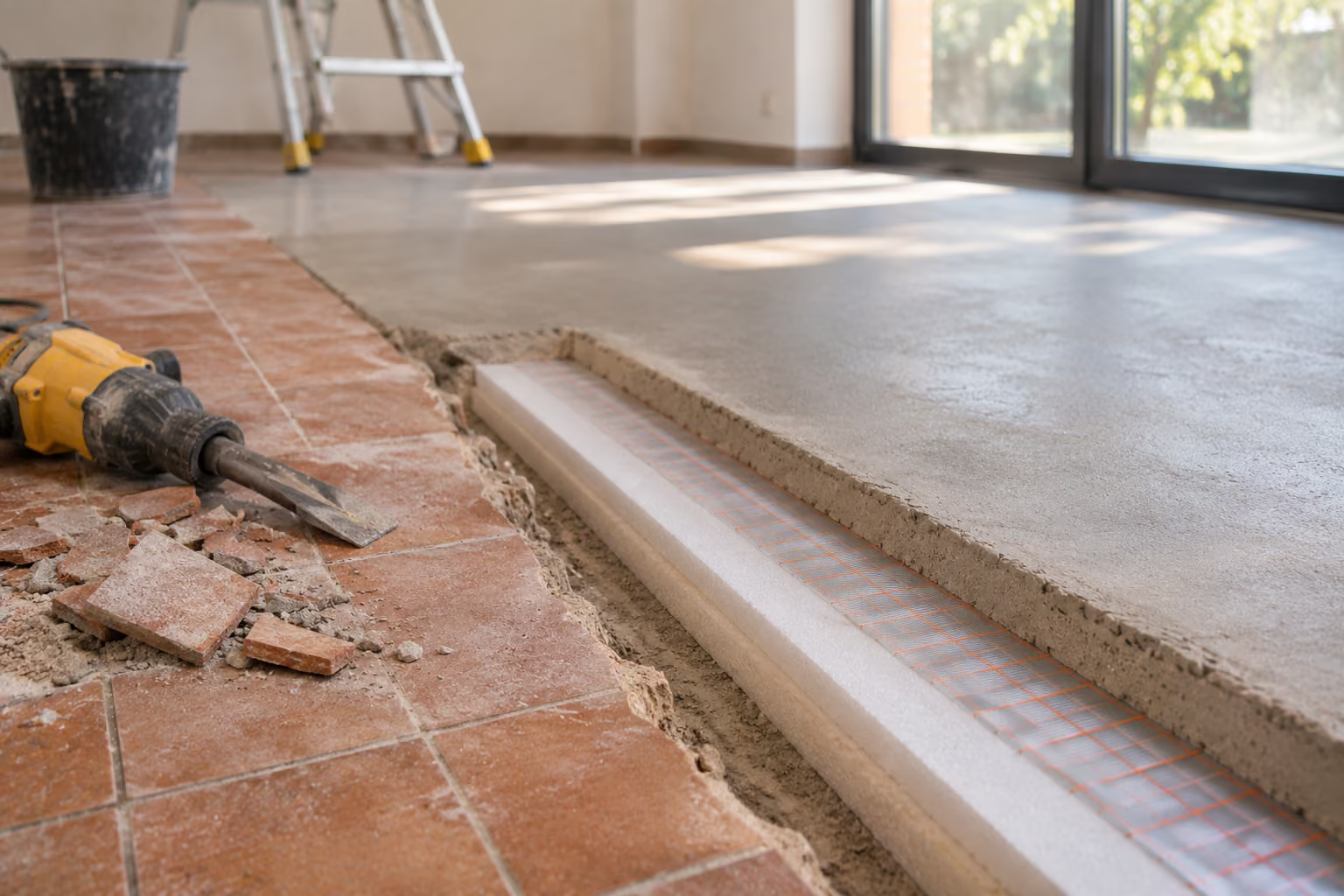
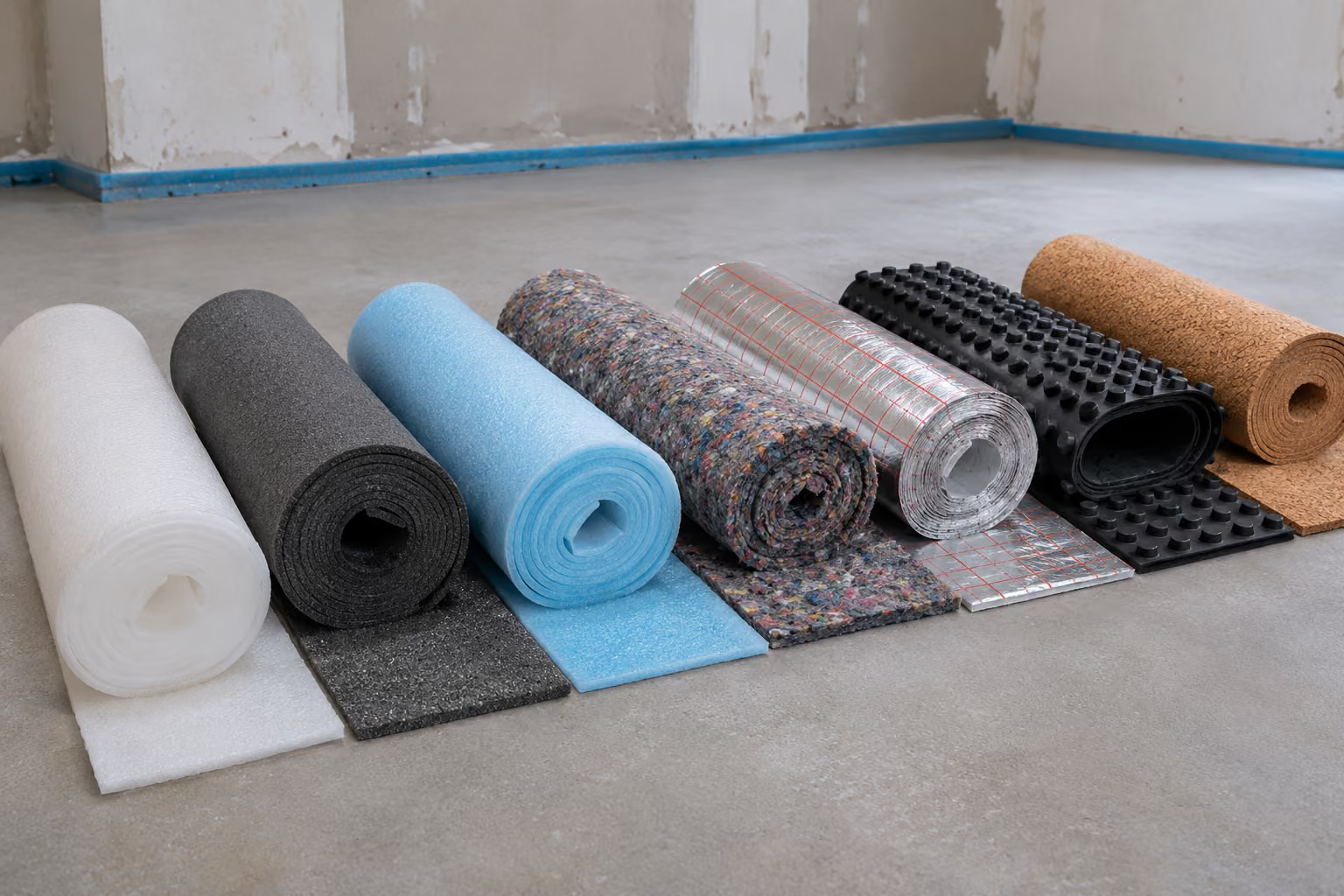
What goes under the screed and along the walls disappears once the floor is poured. That is why these layers must be on the quote.
The membrane or decoupling layer. On insulation, a floating screed is separated by a membrane. On a base exposed to damp, a vapour barrier may be needed: our page on vapour barriers under screed explains when.
Edge strips. An edge strip along walls and columns lets the screed expand and breaks the path of impact noise. Without it, the screed touches the walls: it can crack and it carries footstep noise.
Mesh or fibres. The quote should say whether the screed is reinforced, and how. When reinforcement makes sense is explained in our page on mesh in a screed.
Joints. On a large area, at door openings or over underfloor heating, the screed is divided into sections. The quote should say whether joints are included. The rules are in our page on screed expansion joints.
Insulation. If insulation goes under the screed, four details are essential: the technique (sprayed PUR, EPS mortar, boards), the thickness, the conductivity or brand of the product, and the thermal resistance R achieved. The R-value matters twice: for comfort and for grants. In Flanders, the Mijn VerbouwPremie grant for floors requires a minimum Rd-value and a contractor's certificate (vlaanderen.be, consulted November 2026). Conditions by region are in our article on floor insulation grants, and the choice between techniques in PUR or EPS under screed.
These items do not describe the screed itself. They describe the site, and they are where extras appear halfway through.
Base preparation. Cleaning, a bonding primer for a bonded screed, repairs to a cracked base or breaking out an old floor: the quote should say what is included and what is left to you. The most common base problems are covered in our article on mistakes to avoid before pouring a screed.
Travel and pump. The quote should say how the mortar reaches the room: pumped from the truck, over what distance, to which floor. A third-floor flat with no truck access is not a ground floor with a ten-metre hose.
What is expected from you. Clear access, parking, water and electricity, empty rooms: these conditions should be written down, together with what happens if they are not met on the day. What must be ready before the crew arrives is in our article on laying a screed step by step.
Protection after pouring. Who protects the fresh screed from draughts, sunlight and other trades walking over it? Good practice is in our page on protecting a screed while it dries.
A quote can state a drying time, but it remains an estimate. It depends on thickness, mortar type, ventilation and season. Drying times by screed type and floor covering are in our article on drying a screed before tiles or parquet.
The line that really matters is the moisture test. The quote, or failing that a written exchange, should say whether a test is planned before the floor covering is laid, by which method and by whom. The reference method and the limits are in our page on measuring screed moisture.
If a quote promises a screed "ready in a week" without mentioning a fast-drying screed or a test, ask what that timeframe is based on.
Ten-year liability applies to the contractor for serious defects, for ten years from acceptance of the works. How it works is explained in our page on screed lifespan and guarantees. The insurance that covers it is a separate question.
The Act of 31 May 2017, known as the Peeters-Borsus Act, makes ten-year liability insurance compulsory for contractors, but not on every job. It covers works on a home in Belgium for which an architect is legally required, with a planning permit issued after 1 July 2018. The insurance covers the solidity, stability and watertightness of the closed shell, where the defect endangers the solidity or stability of the home.
Two practical consequences:
Also check the company number on the quote in the Crossroads Bank for Enterprises (KBO Public Search, FPS Economy): name, address and activity should match.
This information is general and does not constitute legal advice.
VAT. The quote should state the rate applied and its basis. The reduced 6% rate applies to renovation work on a home at least 10 years old used as a private residence, invoiced directly to the owner or occupant. For new builds, the rate is 21%. Since 1 July 2022, a statement on the invoice has replaced the certificate (FPS Finance). A quote at 6% for a new house, or with no rate at all, should be corrected.
Payment terms. The quote should say how much, when and against what: any deposit, stage payments, the balance. Tie the balance to a step you can check, such as the end of the job and an inspection of the screed. At Davide Chape, payment is made once the work is finished and approved by the quality manager.
Validity and date. A quote has a validity period and, ideally, a time window for the work. If the job slips by several months, ask whether the quote still stands.
A reliable quote starts with a site visit: the area, the condition of the base, the height available and pump access cannot be guessed remotely. At Davide Chape, the visit and on-site measurements come before a free, no-obligation quote, for every type of screed, sprayed PUR, EPS mortar and acoustic insulation, anywhere in Belgium.
Request your free quote and mention the area, the floor level and the planned floor covering.
Last updated: November 2026. Sources: Act of 31 May 2017 on compulsory ten-year civil liability insurance for contractors, architects and other construction service providers, consolidated text on Justel (Articles 2, 3, 12 and 21), consulted November 2026 · NBN EN 13813, Screed material and floor screeds, properties and requirements · technical data sheets of CT-C20-F4 screed mortars sold in Belgium (Chapmix C20), consulted November 2026 · Buildwise, NIT 189 and NIT 193 (screeds for floor coverings) · FPS Finance, "Renovating: VAT rate", consulted November 2026 · Flemish Government, vlaanderen.be, "Mijn VerbouwPremie voor vloer", consulted November 2026 · FPS Economy, KBO Public Search.

Do not hesitate to contact us directly: our team is always available to assist you and provide a 100% free quote.


Your expert in screeds, thermal insulation, and acoustic floor insulation.