Acoustic underlay for screed: 7 products compared on ΔLw, dynamic stiffness and minimum screed thickness. How to read a data sheet, step by step.
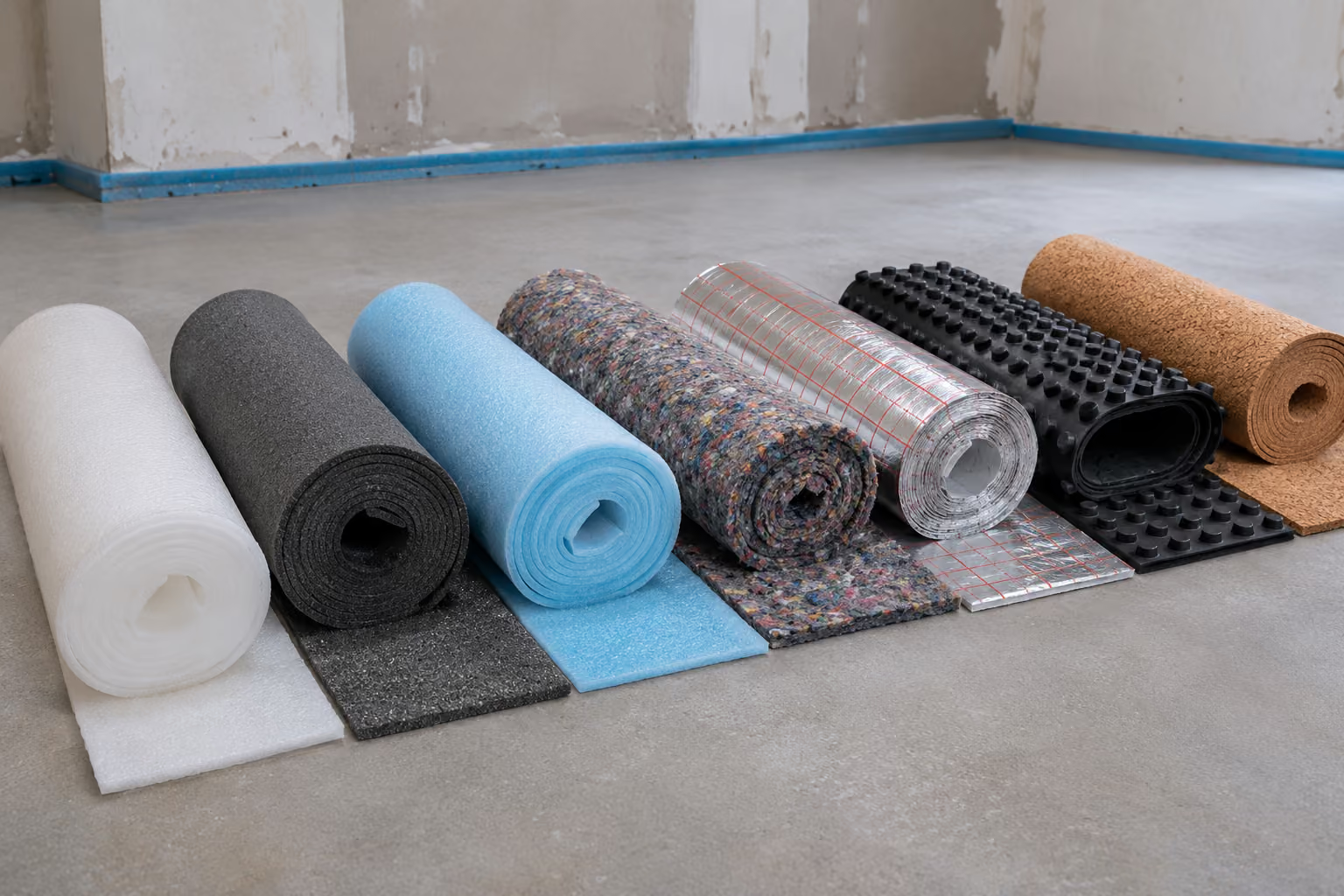
An acoustic underlay for screed is compared on three values from its data sheet: the ΔLw measured on a bare concrete slab, the dynamic stiffness s't and the compressibility. Of the seven underlays Davide Chape uses, only the three Insulit products publish all three values: 26 to 30 dB of ΔLw according to Insulco. For the other four, most data is not published online and has to be requested before choosing.
The essentials in three points
A reliable data sheet gives at least four pieces of information: the ΔLw, the build-up in which it was measured, the dynamic stiffness and the compressibility under load. Without all four, the figure printed on the roll does not help you choose.
ΔLw is the reduction in impact sound level achieved by adding a floating floor to a reference floor. Buildwise defines it as the difference between the level measured without and with the system (ΔL = Ln0 − Ln), under NBN EN ISO 10140 and NBN EN ISO 717-2. The higher it is, the more effective the system.
The figure has two limits, which Buildwise describes in its note « Basisgrootheden contactgeluidsisolatie » (August 2023). It is usually measured on a heavy reference slab of about 14 cm of concrete: on a lighter structural floor, the gain is smaller. And it applies to the tested assembly: if the screed or the levelling layer differs from the lab set-up, the ΔLw differs too.
ΔLw is not the final result in the home either. The Belgian standard NBN S 01-400-1 sets its requirements on the level measured on site, which includes flanking transmission through the walls. The classes and limits of that standard are covered in our article on apartment soundproofing.
Dynamic stiffness, written s' or s't, measures how stiff the underlay is under vibration. It is expressed in MN/m³ and measured under EN 29052-1. The lower it is, the better the underlay works as a spring between the screed and the slab.
Together with the mass of the screed, it sets the resonance frequency of the floating floor. The usual formula in the calculation standards (EN ISO 12354-2) is f0 ≈ 160 × √(s' / m'), where m' is the mass of the screed per m². Lower stiffness or a heavier screed lowers that frequency, and the floor then insulates over a wider frequency range.
That is also why thickness alone says nothing. The principle is explained in our entry on the resilient underlayment: a thin product with low stiffness can outperform a thick, stiff one.
Compressibility shows how much the underlay compresses under a given load, for example "±10% under 2 kPa" for the Insulit range. An underlay that is too compressible lets the screed deflect, which can crack it. That is why each manufacturer pairs its underlay with a minimum screed thickness.
A last, less visible criterion is creep: the loss of thickness under load over the years. Insulco states that it tests the creep of its products under a load of at least 2 kPa. If a data sheet says nothing about long-term behaviour, ask.
The same product can show two very different ΔLw values. Insulco publishes a ΔLw of 26 dB on a bare slab for the Insulit 4+2, and 35 dB on a thermal levelling layer. Both figures are correct, but only the first lets you compare products.
The WTCB (now Buildwise) measured this effect in WTCB-Contact 2021/6. With about 5 cm of levelling layer under a standard resilient underlay, ΔLw changed by +2 to +5 dB for EPS mortar, +1 to +2 dB for foamed concrete and −3 to +1 dB for PU foam. With PU, the loss at high frequencies can even reach 10 dB.
The WTCB's practical conclusion: an underlay laid on a different levelling layer from the one in its test report no longer has a guaranteed performance. If the floor also gets thermal insulation, the whole build-up has to be designed together. The choice between the two thermal insulants is covered in our comparison PUR or EPS under screed.
The table lists, for each underlay on the Acoustic floor insulation page, the values published by the manufacturer. Where a value is not published online, the cell says so: nothing has been estimated.
| Underlay | Material | Thickness | ΔLw on bare slab (on levelling layer) | Dynamic stiffness s't | Compressibility | Minimum screed (manufacturer) | Typical use and underfloor heating |
|---|---|---|---|---|---|---|---|
| Plastifoam | not published | 4 × 2 mm (Acoustic floor insulation page) | not published | not published | not published | not published | not published |
| Ethafoam | Non-crosslinked low-density polyethylene foam (Sealed Air) | 5 mm (Acoustic floor insulation page) | not published | not published | not published | not published | not published |
| Gemafon 6+ | not published | 6 mm (Acoustic floor insulation page) | not published | not published | not published | not published | not published |
| Insulit 4+2 (Insulco) | Crosslinked polyolefin foam + acoustic polyester felt | ≥ 6 mm under 1.5 kPa | 26 dB (35 dB) | ≤ 10 MN/m³ | ±10% under 2 kPa | 5 cm | Entry level, meets NBN S 01-400-1 according to Insulco. Underfloor heating: not stated |
| Insulit Bi+8 (Insulco) | Embossed crosslinked polyolefin foam + acoustic polyester felt | ≥ 8.5 mm under 1.5 kPa | 28 dB (35 dB) | ≤ 8 MN/m³ | ±10% under 2 kPa | 6 cm (2020-2021 catalogue) | Floors between storeys, higher comfort. Underfloor heating: not stated |
| Insulit Bi+9 (Insulco) | Aluminised film + crosslinked PE-EVA foam + acoustic polyester felt | ≥ 10 mm under 1.5 kPa | 30 dB (35 dB) | ≤ 6 MN/m³ | ±10% under 2 kPa | 6 cm | Floors between storeys, best performance in the range. Underfloor heating: yes, pipes above the underlay |
| Réflexe acoustique | not published | 2 × 3 mm (Acoustic floor insulation page) | not published | not published | not published | not published | not published |
Two things stand out. The three Insulit underlays form a graded range, backed by Belgian test reports. The other four products are thinner or less documented, and their performance under screed has to be checked case by case, on the data sheet supplied with the quote.
The three Insulit underlays are made in Belgium by Insulco, in Nivelles. They combine a closed-cell foam with an acoustic polyester felt: the foam works on mid and high frequencies, the felt on low ones, according to the Bi+9 data sheet.
The Insulit 4+2 is the entry level. With 26 dB on a bare slab and a stiffness of 10 MN/m³, it suits projects where budget matters, under a floating screed of at least 5 cm according to Insulco. The manufacturer states that it meets the requirements of NBN S 01-400-1.
The Insulit Bi+8 goes up to 28 dB and 8 MN/m³. With its embossed foam, Insulco aims it at floors between storeys where higher comfort is required. Insulco's 2020-2021 catalogue pairs it with a floating screed of at least 6 cm.
The Insulit Bi+9 is the top of the range: 30 dB on a bare slab, stiffness of 6 MN/m³ at most, screed of at least 6 cm. It adds a tough aluminised film and a self-adhesive overlap of about 10 cm, which secures the continuity of the layer. Its results rest on reports from the Belgian building research centre (AC 4812 Bis in 2010, AC 7614 in 2017). It is the underlay highlighted on Davide Chape's Acoustic floor insulation page.
On a levelling layer, all three reach 35 dB according to Insulco. The difference between them therefore matters most on a bare slab, where there is no thermal insulation under the screed: typically a floor between two apartments.
For these four products, no data sheet giving a ΔLw under screed, a dynamic stiffness or a compressibility could be found online in November 2026. That says nothing about their quality. It means the comparison is made on paper, at quotation stage.
What is known is limited. Ethafoam is a Sealed Air brand of non-crosslinked low-density polyethylene foam, a general-purpose material rather than a product designed only for screeds. The thicknesses shown (4 × 2 mm, 5 mm, 6 mm, 2 × 3 mm) are those on the Acoustic floor insulation page.
As a benchmark, Insulco publishes the values of its simplest thin foam, the Insulit 55+ (5.5 mm, foam only): 22 dB on a bare slab in one layer, 24 dB in two layers, with a stiffness of 61 MN/m³. A thin foam without felt therefore usually performs below twin-structure underlays.
To compare one of these underlays with the Insulit range, ask for four things:
The right choice depends less on the product than on three questions: is there a home below, will there be thermal insulation under the screed, and will there be underfloor heating?
This is the most demanding case, often on a bare slab. The bare-slab ΔLw is the figure that matters, and a twin-structure underlay (foam and felt) with low dynamic stiffness is the benchmark. The regulatory target and the question of available height in a renovation are covered in our article on apartment soundproofing.
In a house, footsteps mainly disturb between the upper floor and the ground floor. Thermal insulation under the screed already helps slightly, but it does not replace a resilient layer. The difference between these options is explained in our article on sound insulation under screed.
An acoustic underlay works with underfloor heating if the pipes sit above it, in the screed. The Bi+9 data sheet states that the pipes must never be fixed through the underlay: they are laid on a mesh or a studded panel that floats. For the 4+2 and Bi+8, the manufacturer does not say so on its product pages. The rules for a heated screed are in our underfloor heating screed guide.
When the floor also gets thermal insulation, the acoustic underlay goes on top of it, then the screed. The WTCB tests show that the insulant chosen matters: EPS mortar improves ΔLw, PU foam can reduce it. The role of that layer is explained in our article on insulating screed.
A high-performance underlay laid badly gives less than an average underlay laid well. Three points make the difference on site:
The mass-spring-mass principle is described in our entry on floating floors. The minimum thickness of a floating screed, regardless of product, is covered in our article on screed thickness by type and substrate.
Davide Chape builds floating floors throughout Belgium, with the seven underlays in this comparison and a floating screed of at least 6 cm, compatible with underfloor heating where needed. The underlay is chosen after assessing the building's acoustic needs, and the continuity of the layer is checked before pouring.
To find out which underlay suits your floor and the height available, request a quote for your acoustic floor insulation.
Last updated: November 2026. Sources: Insulco, insulit 4+2, Bi+8 and Bi+9 product pages (insulco.be, accessed November 2026); Insulco, « Gamma 2020-21 » catalogue (edition 01/2020); Insulco, insulit Bi+9 data sheet (edition 03/2018, Belgian building research centre reports AC 4812 Bis and AC 7614); Buildwise, « Basisgrootheden contactgeluidsisolatie », Standards Antenna Acoustics (August 2023); WTCB-Contact 2021/6, « Akoestische prestaties van zwevende dekvloeren: impact van de uitvullaag » (C. Crispin, A. Dijckmans); Sealed Air, Ethafoam documentation; NBN EN ISO 10140, NBN EN ISO 717-2, EN 29052-1, EN ISO 12354-2, NBN S 01-400-1.

Do not hesitate to contact us directly: our team is always available to assist you and provide a 100% free quote.


Your expert in screeds, thermal insulation, and acoustic floor insulation.