Poured floor or screed? A gietvloer is a 2 to 4 mm finish, the screed is its base. Belgian price per m² and what the screed needs: dry, flat, sound.

A poured floor and a screed are not alternatives to each other. The screed is the load-bearing, level base, several centimetres thick. The poured floor, called a "gietvloer" in Flanders, is a finish of a few millimetres of resin or cement poured on top of it. So a poured floor almost always needs a screed first, and the result depends mostly on how dry, flat and sound that screed is.
The essentials in three points
A poured floor is a seamless floor finish applied as a liquid that levels itself. It gives a continuous floor, plain or with a clouded effect, popular in modern homes, open kitchens and lofts. In Belgium and the Netherlands it is known as a "gietvloer".
There are three main families. A polyurethane (PU) poured floor stays slightly flexible, feels warmer underfoot and is the most common choice in homes. An epoxy poured floor is harder and more wear-resistant, and is mostly used in garages, workshops and commercial premises. A cement-based poured floor or microcement has a mineral, concrete-like look.
The layer is thin. The manufacturer G-vloeren gives 2 to 3 mm for a decorative PU poured floor. A full system usually consists of a primer, a levelling or scratch coat, the poured layer and a protective top coat. That work is done by a poured-floor specialist, not by the screed contractor.
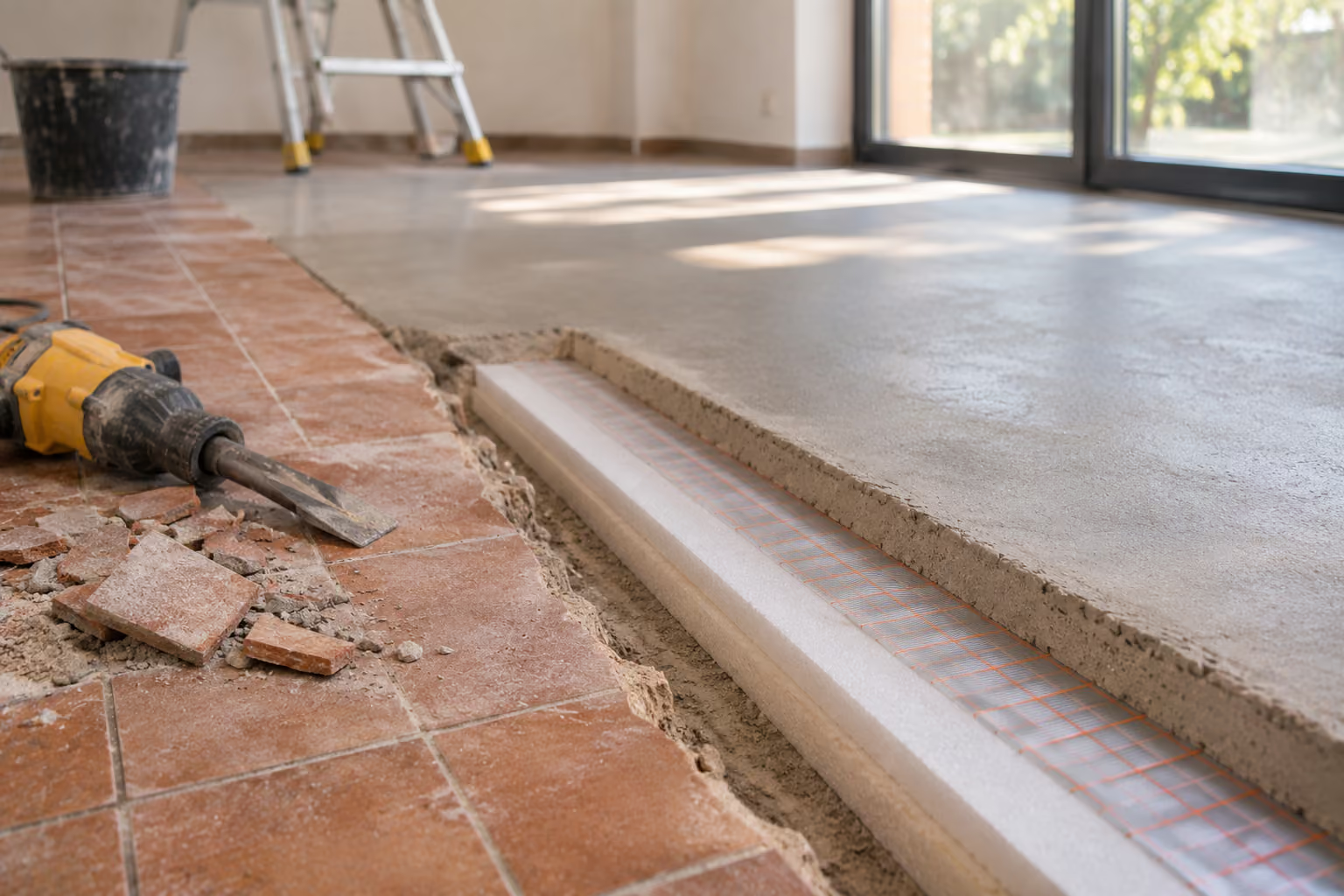
A screed is a layer of sand-cement mortar, or of flowing mortar based on cement or anhydrite, laid on the concrete slab or on the insulation. It carries and spreads the loads, embeds the underfloor heating pipes and brings the floor to the right height.
A screed is measured in centimetres, not millimetres. Its minimum thickness depends on the type of screed and on the base (bonded, floating, on insulation): these minimums are set out in our article on screed thickness by type.
The European standard NBN EN 13813 classifies screed materials by binder: CT for cement, CA for calcium sulphate (anhydrite) and SR for synthetic resin. Technically, a resin poured floor belongs to the same family, but at a completely different thickness and with a completely different role.
The two layers differ on almost every point: role, thickness, material, trade and price. The table below compares them.
The key point: the screed makes the floor, the poured floor finishes it. A poured floor on a poor screed is an expensive finish on a weak base.
Sometimes, but only if the existing base already meets the same requirements as a new screed. A sound, flat concrete slab or an existing screed in good condition can take a poured floor. So can well-bonded tiles, after the applicator has sanded and primed them.
On a rough slab covered with pipes and conduits, directly on insulation or on a timber floor that flexes, it cannot be done. A screed is needed first, or a suitable solution in the case of timber: see our page on screed on a timber floor.
A screed that will carry a poured floor must meet four conditions: dry, flat, sound, and with a clean surface the finish can bond to. On anhydrite and on underfloor heating, extra points apply.
A poured floor is almost vapour-tight. Moisture left in the screed can no longer escape and causes blistering or debonding. Bostik describes the calcium carbide (CM) test as the only official method for measuring residual moisture: material is taken from deep in the screed, the surface is not what counts.
The limits vary by type of screed and by product. Bostik and Arturo do not publish exactly the same figures, so the technical sheet of the chosen poured-floor system always prevails. How to measure and which values are usual is explained on our page how to tell if a screed is dry, and drying times in our article on screed drying before tiling or flooring.
A layer a few millimetres thick follows every ripple and ridge in the base. In low sunlight through a window, every defect shows. That is why the applicator often lays a levelling compound first, even on a good screed.
The flatter the screed, the thinner and cheaper that levelling layer. Usual tolerances and the 2 m straightedge check are covered on our page on screed flatness tolerances. The difference between a levelling compound and a screed is explained in self-levelling compound vs screed.
A poured floor is only as strong as the layer it bonds to. For floor finishes in general, Bostik asks for a compressive strength above 8 N/mm² and a tensile strength of at least 0.5 N/mm². Poured-floor manufacturers may require more.
Areas that sound hollow or are cracked must be repaired first. See our pages on a screed that sounds hollow and a screed that cracks.
Movement and contraction joints in the screed must be carried through into the poured floor. A poured floor laid straight over a joint nearly always cracks right above it. Where these joints are needed is explained on our page on screed movement joints.
Both can take a poured floor. A flowing anhydrite screed is naturally very flat and needs few joints, which makes it a good base. But its surface forms a laitance that Bostik says must be sanded off, and the moisture limit is much lower than for cement.
Bostik also warns that an epoxy moisture barrier, the usual fix for a cement screed that is too damp, cannot be used on anhydrite. A sand-cement screed is more forgiving, but its rougher surface more often needs a levelling layer. The differences are covered in anhydrite screed vs cement screed.
A poured floor on underfloor heating is possible, on two conditions. The screed's heating-up protocol must be fully completed before the floor is poured, and the screed must then be dry enough according to the CM test. A PU poured floor, which stays flexible, copes better with the small movements of a heated floor than a rigid layer.
The heating-up protocol and the suitable screeds are covered in our underfloor heating screed guide.
The real choice is not between a poured floor and a screed, but between the finishes that go on the screed: poured floor, tiles or wood. A few situations make the choice clearer.
You want a seamless floor without joints. A poured floor on a flowing or very flat screed is the logical combination.
Floor build-up height is limited. A poured floor takes only a few millimetres, glued tiles take more. That advantage only works if the screed is laid at the right height: the finished floor level must be fixed before the screed is poured.
Garage, utility room or workshop. An epoxy floor on a cement screed is common here. Outdoors, anhydrite is ruled out: see our article on outdoor screed.
Budget. With a poured floor, always count three items: the screed, the levelling and the poured floor itself. A cheap poured floor on a screed that needs a lot of levelling soon costs more than expected.
Almost every poured-floor problem starts in the base. These mistakes come up most often.
A poured floor costs from roughly €60/m² in Belgium, installation included. Bobex gives prices from €60/m² for epoxy and from €75/m² for PU (checked November 2026). Trustup also starts at €60/m² for a self-levelling poured epoxy floor (2026 prices).
Preparation is not always included. Trustup puts levelling from €15/m². The screed itself comes on top: market prices by type of screed are gathered on our page on screed prices per m² in Belgium.
The price per m² depends on the type of resin, the number of coats, the area, the condition of the base and the finish. Small areas cost more per m². These are market prices, not Davide Chape rates: Davide Chape does not lay poured floors.
Davide Chape does not lay poured floors. We lay the screed underneath, anywhere in Belgium: sand-cement, flowing cement or anhydrite, on insulation or on underfloor heating.
Mention in your request that a poured floor will go on top: a screed contractor who knows this can match the height, flatness and type of screed to the finish from the start. Request a quote for the screed under your poured floor.
Last updated: November 2026. Sources: Bobex.be, poured floor prices (checked November 2026); Trustup.be, epoxy floor and levelling prices (2026); Bostik Belgium, substrate preparation; Arturo (Uzin Utz) technical sheets; G-vloeren, PU poured floor technical sheet; NBN EN 13813.

Do not hesitate to contact us directly: our team is always available to assist you and provide a 100% free quote.


Your expert in screeds, thermal insulation, and acoustic floor insulation.